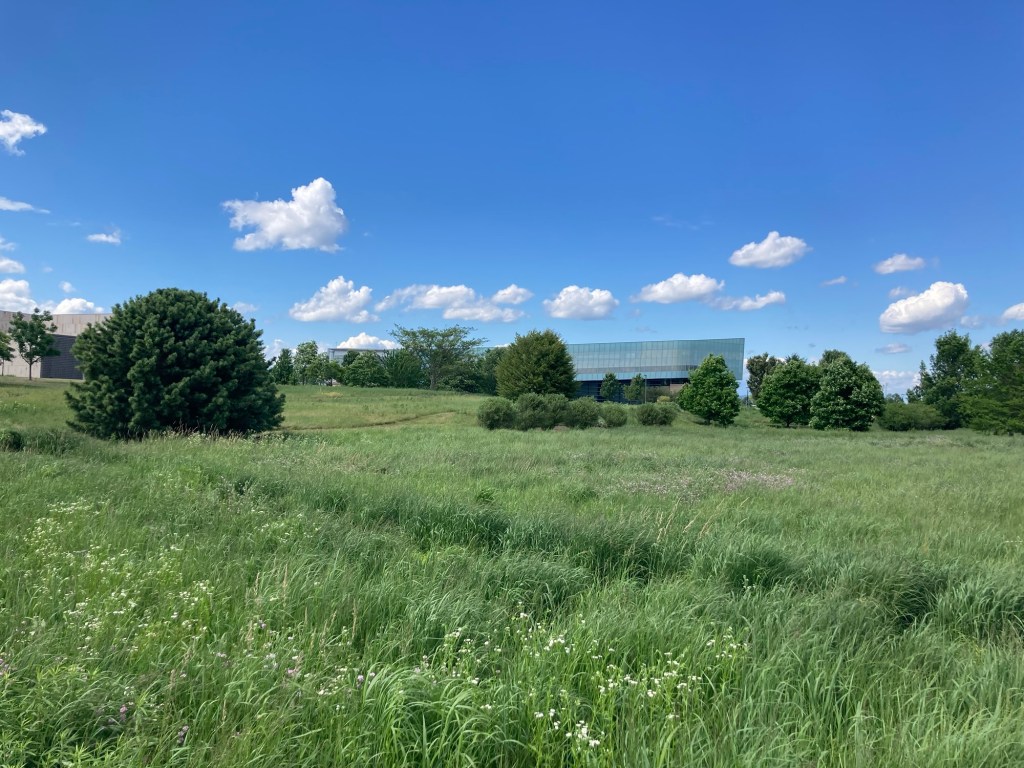
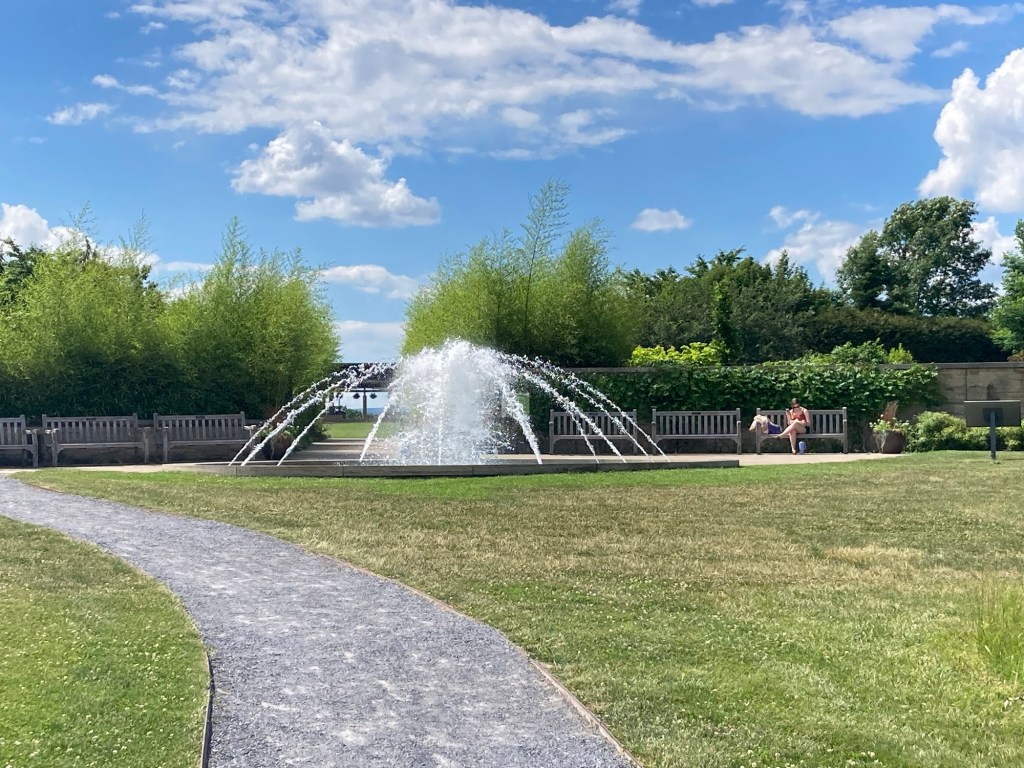
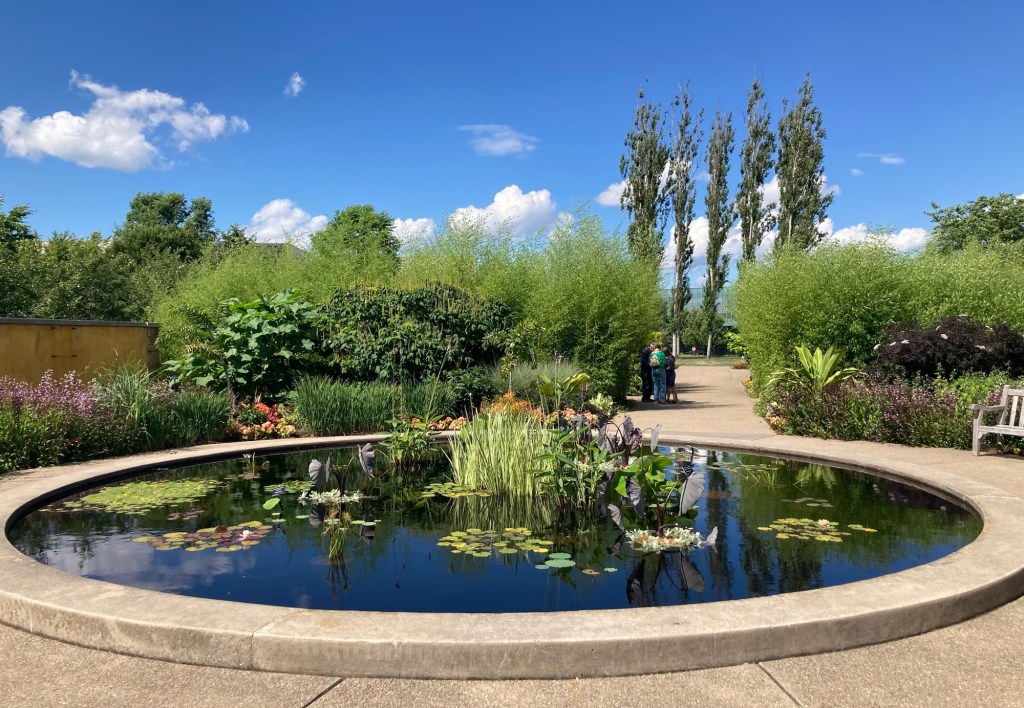
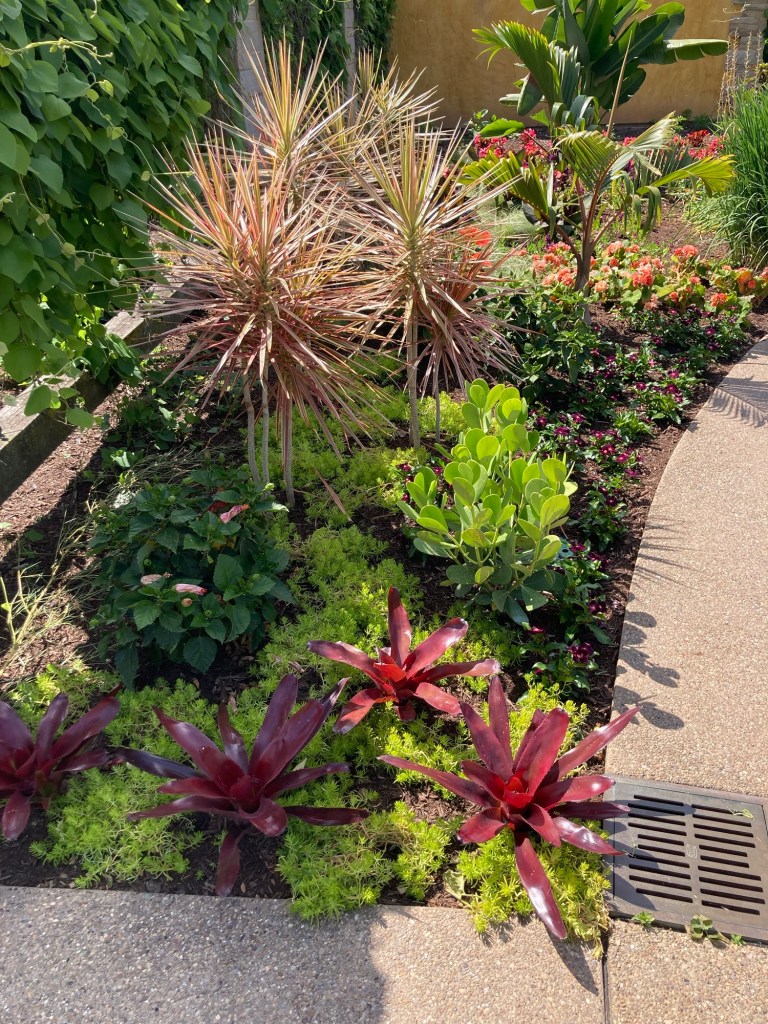
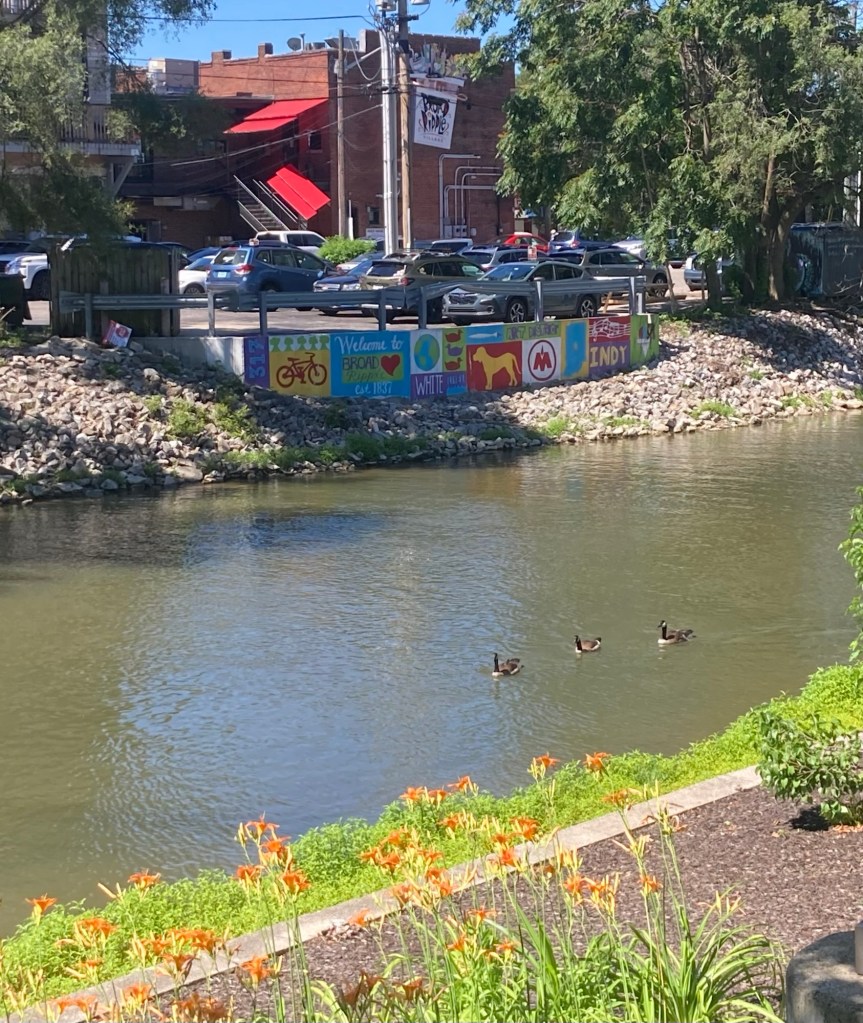
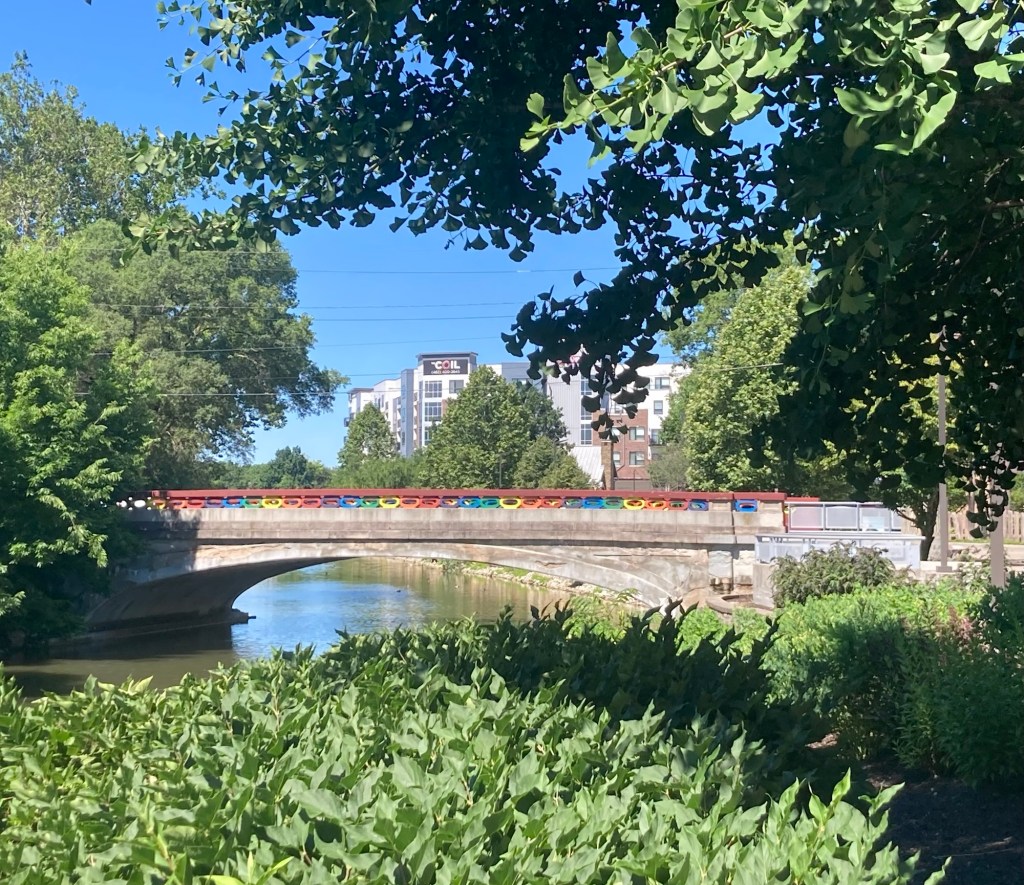
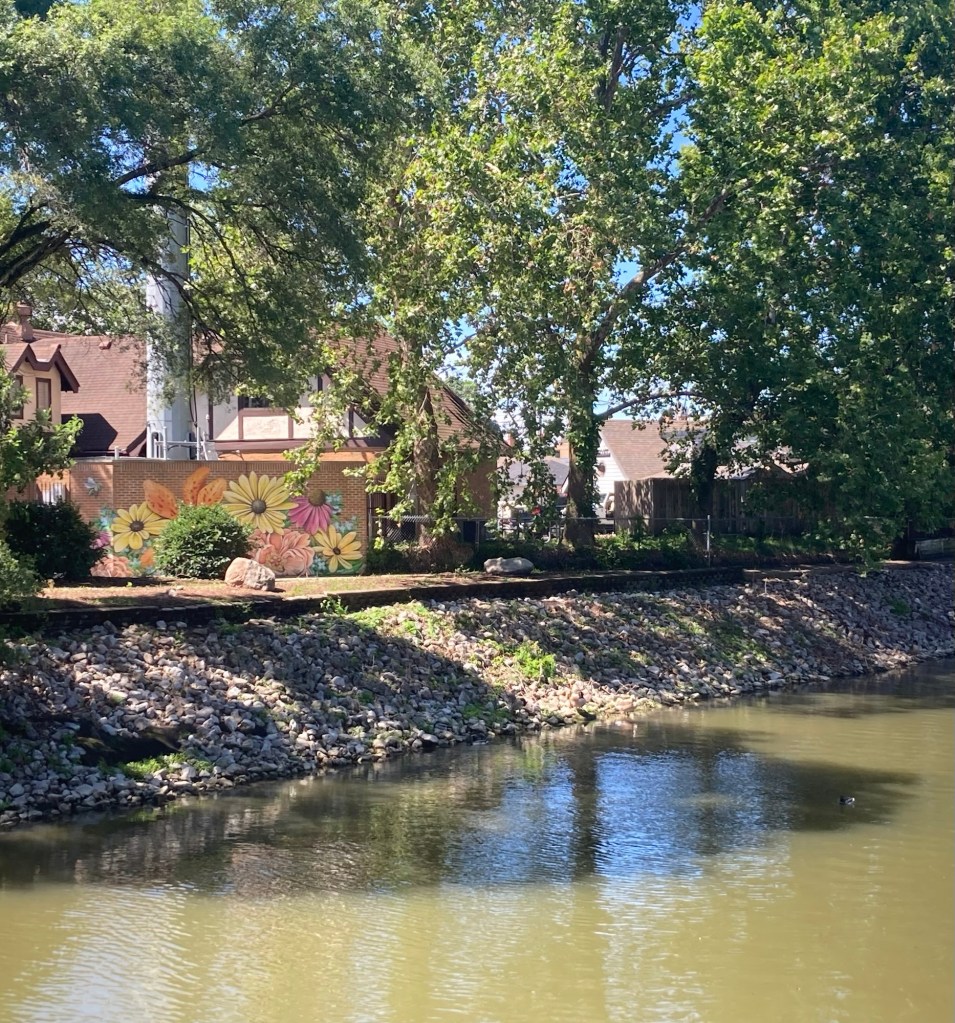
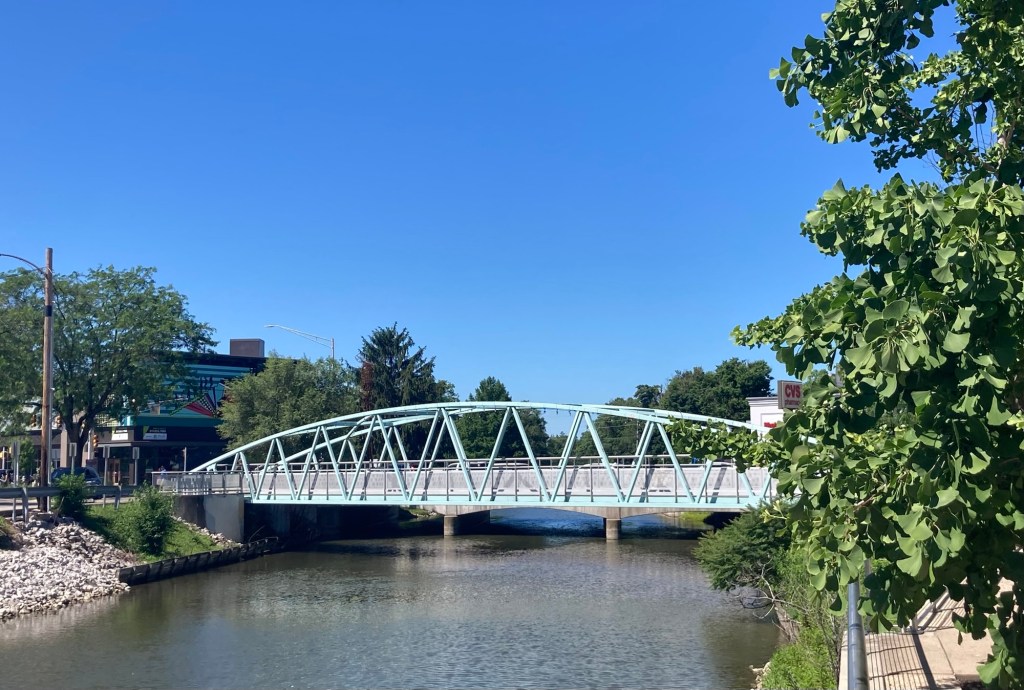
Bob and I returned to our room about 1:00 pm from our tour. Bob was ready to chill given his hip problem, but I was up for getting out. I decided to walk about 25 minutes to the Lido Beach and then walk south along the coast towards a fishing village. This area has a lot of very nice hotels, natural and private swimming areas, etc, The following are my photos of the walk out and back with minimal descriptions. You will notice that the beaches are black and/or rocky.
A statue to John Goncalves Zarco (1390-1471), a Portuguese explorer who established settlements and recognition of Madeira islands.I missed this walking out, but found this dark tunnel on the walk going back towards the hotel. This was a peek out through the rock.Getting to the end of the tunnel
Once Bob and I understood that walking was difficult for Bob, we booked 2 tours for while we were in Madeira — one full-day tour and one half-day tour. Today was our half-day tour to Nun’s Valley.
We were to be picked up between 8:55 and 9:10 am. Our driver, Eduardo, picked us up almost 10 minutes early. It turned out to be one of my least favorite tours ever. There were only 6 of us on the tour, so the tour company ( the same one we used last Friday) used a smaller vehicle. There were 2 seats alongside the driver and 2 sets of three seats behind. We were the first couple picked up and were put in the seats next to the driver since another couple had requested the row of seats immediately behind the driver. This was a tight fit for the whole trip with me between Bob and the driver, holding my backpack on my lap.
If anyone knows me,they will know that I like a certain amount of personal space and certainly don’t want somebody right next to me blathering on during the whole trip. Mostly, he wanted to share information about the local flora, but I see no need to stop in the middle of a highway to share any information, let alone the different colors of calla lillies that can be found in Madeira.
We stopped initially at a viewpoint over Funchal called Pico Dos Barcelos. It was a nice 360 degree view, although at the time we were there it was too hazy over the ocean to get good ocean views.
The viewpoint Looking over the cafe terrace below the viewpoint Pretty flowers at the viewpointA different view of FunchalDittoBob capturing me looking out at the greater Funchal area
The 2nd stop on today’s tour was at Eira do Serrado, which overlooked the Nun’s Valley. It consisted of a hotel, souvenir shop and cafe near a steep slanted and then stepped walk to a viewpoint over the Nun’s Valley. I was a bit miffed that the tour company hadn’t suggested another trip for us as I had said that Bob was walking with a cane. He was unable to get to the viewpoint.
A fun sign at the start of the walk to the viewpointLooking down on Nun’s Valley, so called because the local nuns took refuge in this valley when the island was occupied by piratesWalking up to the viewpointThe cafe and retail on the terrace outside of the hotel at the viewpoint The view of the back of the hotel walking back from the viewpoint The view from the parking lot across the valley
Finally, our last stop was in the small community of Nun’s Valley. We had 45 minutes in a town with a few shops, a church, and a museum.
The local museum on the left overlooking the parking lot that we stopped at.A local bar/cafe in which Bob tried a local delicacy while I poked around townThe chestnut and cheese cake that’s a local delicacy. The staff described it as savory, but it tasted a bit sweet without a strong taste of cheese or chestnuts.Looking down the Main Street of townLooking up into the tiered townThe local church A view of the church from the naveThe ceiling over the naveThe ceiling over the alterThe alter of the church
Bob and I decided last night to head to the large Savoy Palace (residences and hotel), which looms over our little hotel, as Bob had found that they had a rooftop bar. Upon entering, those of us who are not guests or residents of the multiple Savoy properties in Madeira are required to pay 30 euros up front for a card as a minimum charge. Any amount spent over that would be charged at the bar. Since we had seen that their cocktails cost about 15 euro anyway, we were okay with this. We paid the nice hostess, got the card, and were escorted to the elevator for the ride up to the 16th floor.
The open air barA view from the barOverlooking the infinity pool next to the bar
We just had our 2 cocktails and then went to our little supermarket to pickup dinner. On the way, we scored a big head photo for Bob.
We couldn’t find any plaque about the name or sculptor
Today, Bob decided to hang out in the hotel (room, lobby, courtyard) as tomorrow we have another tour. I decided to walk to some viewpoints around Funchal. I also saw a bit of Old Town and more impressive sculptures. There is also a bit of a soundscape included near the end, but there are few notes. Basically, just a set of photos around Funchal.
Such a cute location for a cafeChurch of St Mary Major, dating from the 18th century The interior of the church.
After a couple of viewpoints along the coast, I walked up a ways for the next viewpoint.
I don’t know where this gated driveway led, but the flowers were impressive.
I walked down from the 3rd viewpoint and walked through the Old Town portion of Funchal. Lots of narrow cobblestone streets, cute small restaurants, and lots of painted doors.
Lots of tiles on a traditional Portuguese restaurant, also referencing fado, the Portuguese folk music
I found another viewpoint listed on my phone, so back up.
This viewpoint had an avocado or mango tree growing in it.
I then decided to start heading back to the hotel but found a garden and fort to check out on the way.
A big tower and flea market in the Garden of St Lucia
Some talkative frogs in the park pondOne of at least 2 casinos in FunchalOne side of the Fortress of St John the Baptist, erected during the first decade of the 17th century as part of an integrated defense system for the island The swimmers in this pool have an awesome view over the city to the ocean
A few Wikipedia facts about Madeira and Funchal. Madeira is an autonomous region of Portugal in the Atlantic Ocean, about 500 miles southwest of mainland Portugal and 520 miles west of Morocco. It was discovered in 1418 and claimed by Portugal in 1419. The word Madeira means wood in English. The entire island (actually archipelago) has a population of about 250,000. Funchal is the capital of the region. Funchal’s population of just over 105,000.
Bob and I decided to stay in Funchal today and took a Bolt into the town center to check out the market and a bit of a Main Street that runs from near our hotel to near the market. It was hopping. We can’t imagine how busy this place must be in the high season.
The market building, opened in 1940 and designed by Edmundo Tavares.We’re in Portugal, so of course there is beautiful tile work adorning the walls of the marketA liquor store where even the ceiling is covered in bottles Colorful produce. The fruit has been amazing here.The Black Scabbard or Espada fish, a typical fish in Madeira
After we left the market, we made our way along the Avenida do Infanta for a few blocks before Bob caught a Bolt back to the hotel (sort of — the driver left him at the sister property and Bob had to make his way up hill to our room).
The tower of the Funchal Cathedral Inside the cathedral, which opened in 1508
Also along the street were a series of brightly colored vendor huts selling typical Madeira products, often including alcohol.
The pink hut was advertising cocktails including one called a Nikita (not yet tried by us) that is supposed to be a combination of beer, ice cream, and fruit. No idea why.
I checked out two very pretty parks along the street. The first one, in the direction I was headed, was the Municipal Garden. The next few photos are of this garden, which in 2000 won a Gold Award for the European Competition for Cities and Towns in Bloom.
Onward down the avenue where the sidewalks are covered in tiles (not unusual for Portugal), including a center pedestrian median that ran for a block or two.
The pedestrian median
The next park I explored was the Santa Catarina Park, which runs for a number of blocks from the Avenida do Infanta to the Avenida do Mar along the water. It is at a higher level than the seafront, so also provides some lovely views to the Atlantic.
This is the roundabout right outside of one entrance to the park, with the entrance being through the arched brick structure.Looking out to the marina, as I’m walking up into the parkLooking over the gardened wall towards the portLoved the colorful tree. The berries look like pomegranate seeds.Another water view from the parkNo idea what this is, but very unique to meA pond in the park
Along the street were some government buildings and banners advertising the start of a European Summit here on Monday.
This looked like a government or embassy building A view from my walk. Love all the greenery!Another statue in a roundabout
Today Bob and I took a full-day Discover Madeira tour to the west and then north of the island. We had a full van of a driver and 14 guests.
We learned a little bit about Madeira. First, bananas are a main crop, and we saw banana trees all over the terraced slopes of the island. The bananas are only exported to mainland Portugal due both to limits of production and EU standards for size, etc of fruit. Sugar cane is also a main crop, and we saw lots of eucalyptus and then laurel trees, one variety of which provides the bay leaf for cooking.
It is also an island of tunnels, with almost 200 on the island to facilitate transportation. We had 8 stops during the tour.
A photo from the bus to show the terraced slopes of banana treesThe red flowers are pointsettias
Stop 1: A viewpoint of the fishing village, Pico Da Torre
Pico Da Torre from aboveAnother viewThe fun looking, curved plant is aptly named a Swan’s Neck
Stop 2: A pay to view stop at Cabo Girao. There is a glass floor viewing platform here.
The sign at the entranceLooking down the cliff through the glass platform Looking across the coast from the viewing platform A view from the van showing a couple of the many tunnels
Stop 3: The small, pretty community of Ribiera Brava.
Looking back towards the town center from nearer the coastThe tourist office in a plaza near the coastNatural beach umbrellas on the small public beachA pretty church in the terraced town
Stop 4: We then drove to the top of the west part of the island to Fanal, which is a UNESCO site to help preserve the native laurel trees.
A view of us above the cloudsA caldera at the top of the mountain
Stop 5: A brief photo stop at the Ribeira Da Janela, as we came back down the mountain before reaching our long stop for lunch
The phot-op plaza
Stop 6: A 1.5 hour stop at Porto Moniz in the north of the island. This town is known for its rock with a window and its natural pools.
The rock with the windowThe public natural poolsThe black basalt rock and gorgeous blue water Private natural pools in front of a brew house where we had lunchLooking over the sea walk towards the public poolsA waterfall near the town aquarium
Stop 7: A photo-op of a waterfall near Seixal, also along the north coast
The bride’s veil waterfallThe view in the opposite direction
The 8th stop was another photo-op of a waterfall, this time near Sao Vicente
Last night we ate at the hotel restaurant. We had great seafood — clams and octopus — and a great local bread — bolo do caco (flat bread made with sweet potato and served warm with garlic butter).
The dining room of The Brothers Restaurant at our hotel
This morning after breakfast (included with room cost and served in the same dining room), Bob and I walked around our hotel and walked down to the sister property. Almost all walking is up or down here. It reminds us of the Amalfi Cost, and is sadly less than ideal for Bob’s hip at the moment.
Our room in front of the much larger Savoy Palace Residences behind usTo get to the sister property, we walk down through the garden by our pool, out a gate, down a street for a bit (watching for traffic as warned by posted signs), and then across this bridge.The view from the bridge, looking south along the Atlantic Ocean.Looking back inland
After returning to the room to collect some things, we returned the same way, took the elevator down from the bridge to the ground level, walked through the lobby of the sister property and out onto the street to reach the lovely and busy Avenida do Mar to see a bit more of Funchal. There were two cruise ships in, so it was hopping. Bob walked for about half of it, and then had to stop and took a Bolt (like Uber or Lyft) back to the hotel. I continued to the end of the pedestrian promenade along the water and then did my run.
A cool design building built atop what looks to be an old fortress A museum along the promenade in a hotel also named for the famous footballer I found a public bathroom in a pretty park up the hill from the promenade and got a nice shot of one of the cruise shipsOne of many cafes along the wayA cool sculpture to immigration There were a number of small gardens or parks along the promenade. This one has a bust of Gandhi.A colorful Madeira sign and popular photo opLooking across towards the townAnother pretty parkFood and drink trucksMonument to FreedomLots of stone barriers along the coast“Cabra Cega (blind goat or blind man’s bluff),” by Silvio Cro, 2000.
Tomorrow, we have an all-day tour to the west part of the island.
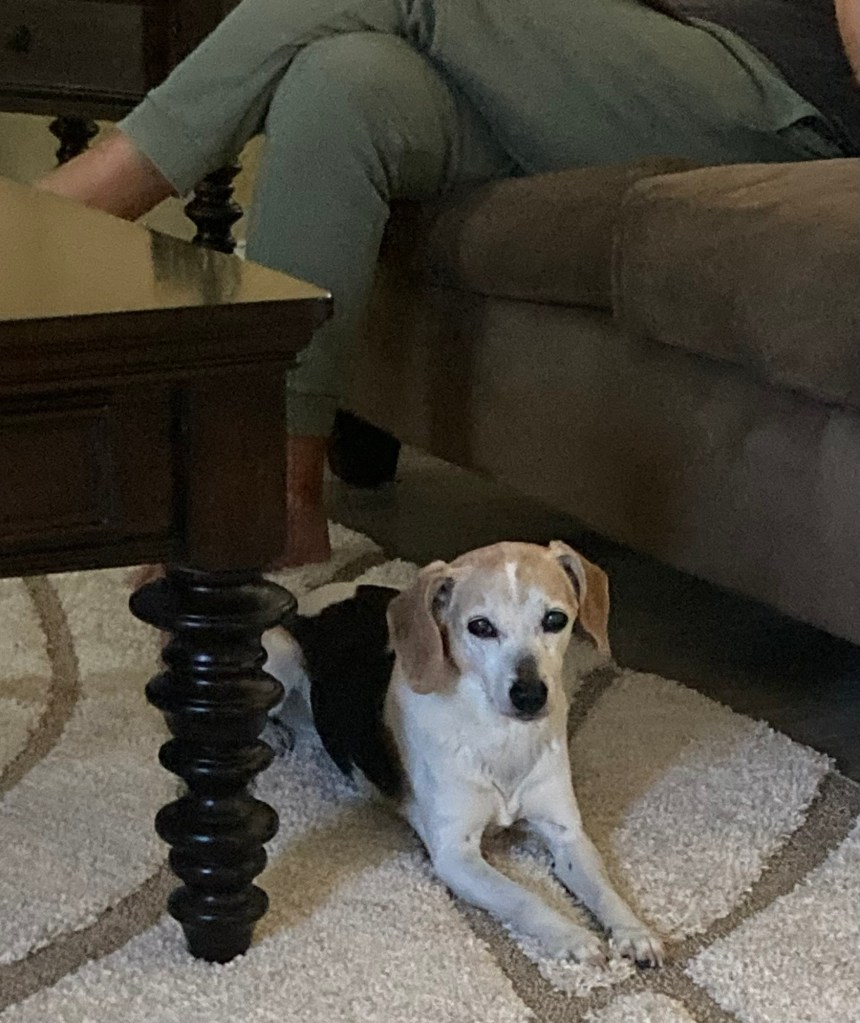
Bob and I left our housesit in Tunbridge Wells and the sweet Nellie on Tuesday. Our very generous homeowners made a car reservation for us to take us from Tunbridge Wells to the Hampton Hotel at the Gatwick Airport. It seemed to be a good sign that our driver was from Portugal and the hotel receptionist was from Madeira (our Portugal destination).
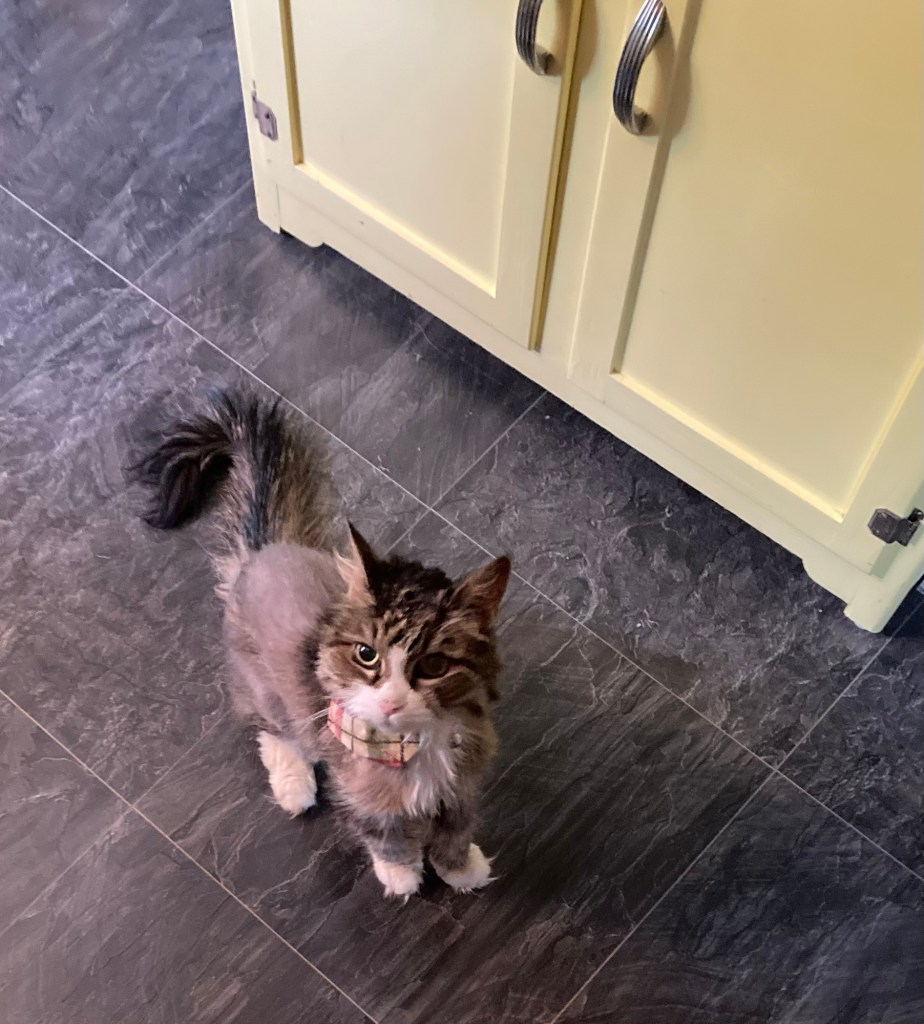
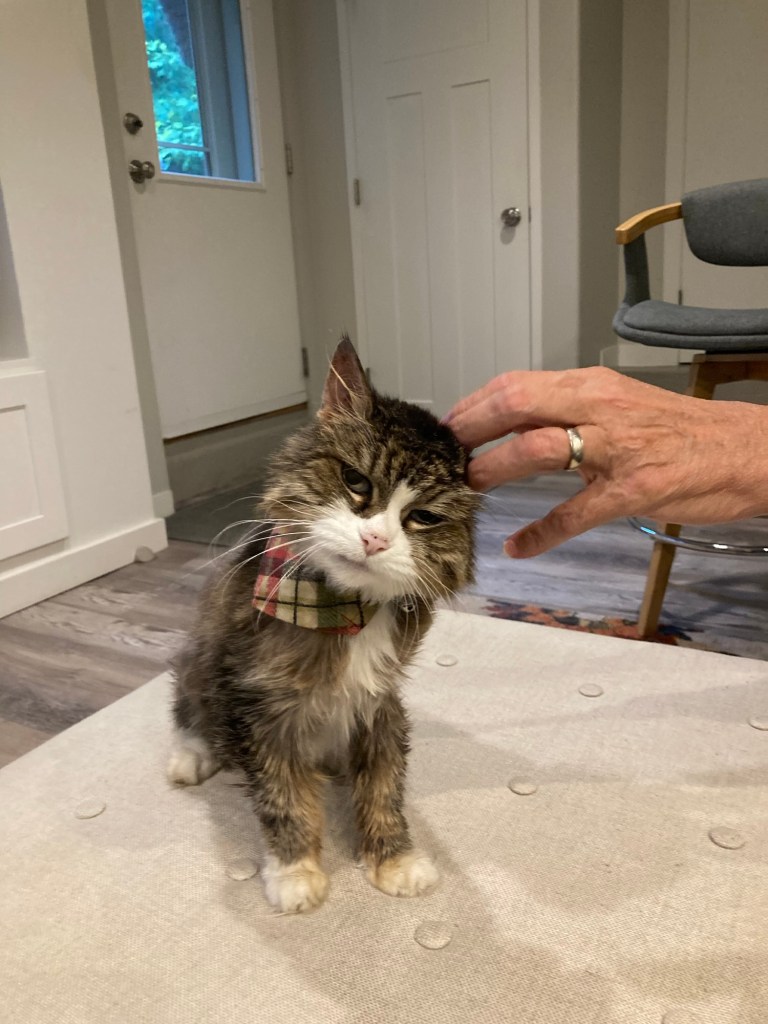
Sweet NellieA rare moment of sun in Tunbridge WellsOn the last maid’s day, Bob and I took the bus to the Sainsbury’s grocery store and then walked across the way to the Smith and Western Hotel/bar.A chuckwagon table The Cowboy themed restaurant Saddle bar seatsBob getting ready to check into the Hampton, North Terminal Gatwick
Once we started on our journey today (after a good workout for me in the Hampton fitness center and then a free breakfast), it was a quick 5 minute walk to the EasyJet gate. We had asked for special assistance with Bob’s hip, so after we got through security, we waited in the special assistance lounge until 1:00 pm when we were taken by a special assistance hostess all the way on board our flight. It pays to be disabled,
It wasn’t as handy once we landed, as we had to wait to debark until the very end and then we were walked quite a ways to customs, where we went through the new enhanced EU screening before picking up our luggage.
Coming down the escalator in the Madeira Airport to claim our luggageA sign to remind us where we are
We grabbed a cab ( number three in line that would take credit cards) to take us from the town of Santa Cruz to our hotel in Funchal (about $50). Once in our room, we unpacked while enjoying a free bottle of sparkling wine from hotel.com through which we had made the hotel reservation,
I took advantage of a Tuesday dog walker’s day to do a final train trip out of Tunbridge Wells. This time I went all the way to the coast (about a 35-40 minute ride depending on the number of stops) to the town of Hastings (as in the Battle of Hastings, which as we all now know happened in the current town of Battle).
Hastings has a current population of about 91,000, and Wikipedia tells me that it remains a popular seaside resort and fishing port, with the UK’s largest beach-based fishing fleet. I definitely saw a number of fresh fish vendors in my 2.5 hour walkabout.
A helpful map posted right outside the train station A transportation hub — train and bus station
My first walk was down to the beach to see the Hastings Pier, which I sadly deleted photos of when I was editing my photos on the train ride back to Tunbridge Wells. Lesson learned (hopefully) about multi-tasking on a moving vehicle.
This is the best that remains of a lifeguard station, the pretty beach, and the pier in the distance.I love this sculpture not far from the lifeguard station. It looks like the remains of an old ship. There is a shipwreck museum further along the coast.
I was walking along the coast towards the East Hill. Hastings has two hills — East Hill and West Hill — both of which you can ascend via funicular (when they are not closed for necessary maintenance). I wanted to go up to the top of the East Hill, as there is a country park there and the views (when not raining or foggy) are supposed to be good. As I learned through some posted signs, neither funicular was running, but I was still able to get to the top of the East Hill.
Some discoveries before I got to East Hill —
Hastings first living laboratory for climate-resilient gardening, right along the seafront The British Tea Museum, only open for tours to groups of 20 or moreEntering into the Old Town section of Hastings One of many pubs along the waterfront A plaque states that this statue was erected on Winkle Island by members of the Hastings Winkle Society. Winkles are a small mollusks with a spiral shell.The Hastings Contemporary, an arts charity located on the historic fishing beachOne of a number of passageways in Hastings. At the top of the stairs, I saw a sign for East Hill, so I went up.More stairs up to the funicular building at the topA view on the way up over the town to the West HillThe entrance to the Country Park at the top of the stairs. The paved path led to a large green space which I didn’t opt to walk on due to the wetness.A view of the beach, town, and West Hill from the top
The rain had returned, so I made my way back down to continue walking east along the coast.
One of the many fresh fish vendors near the waterThe free Fisherman’s MuseumThe free Shipwreck Museum
I briefly went into the Shipwreck Museum, but both this and the Fisherman’s Museum were being used for lessons for a school class. I did get to see the world’s earliest archaeological evidence of a ship’s steering wheel which was recovered on the Goodwin Sands in Kent. I also learned about Samuel Pepys role as Secretary to the Admirality during the reign of Charles II and James II. Prior to this trip, I only knew Pepys for his diary, but we saw a show on tv the other day about the Great Fire of London, in which Pepys played an important role. Both of these efforts (naval and fire) were likely detailed in his diary, but I don’t remember the contents of what we read in school.
The pretty entrance and funicular rail for the East Hill, when operating
I then walked back into Old Town to do more exploring there.
The Flower Makers’ Museum, dedicated to the making of artificial flowers, but not openThe Old Town HallSome older looking homes along the high streetAnother pretty passageway This was the location of the Swan Inn, first recorded in 1523 during the reign of Henry VIII. It survived fires by the French during the 100 Years War and was completely rebuilt in 1889. However, it was completely destroyed by a low-flying enemy bomber on May23, 1943, with considerable loss of life.St Clement’s ChurchA cute pub in Old TownA mosaic- covered pedestrian walkway
One of the most important battles in English history was the Battle of Hastings in 1066. If you have ever had a British Lit course or other American or World history course, you likely have come across this event at some point. To go to the site of this battle though, you would head today not to the town of Hastings, England, but to the town of Battle about 6 miles northwest.
I headed to Battle by train today to look at the site of the important battle, see a bit of the town of Battle, and then look at what remains of the abbey that was built by the battle’s victor to commemorate those who died in the battle.
It was a 30 minute train ride south to Battle, which gets its name from the Battle of Hastings. (Guess the only other option for the town name would have been “Of” since Hastings was already taken.). Its current population is about 6,700.
The Battle Rail Station, completed in 1852 and designed in the style of the Battle Abbey.A pub near the Battle Rail StationWalking along the abbey wall on the way to the entrance St Mary the Virgin Church near the abbey and battlefield Stores and a plaza across from the entrance from the abbey and battlefieldA close up of some Valentines themed yarn art in front of the entrance
A bit of background on the battle and abbey. The English Anglo-Saxon King Edward the Confessor died without an heir in January of 1066 which set up a struggle for succession to the throne. The two armies at the Battle of Hastings were that of the Anglo-Saxon King Harold, who claimed that Edward had wanted him to be king, and William, Duke of Normandy, a region of France. Both wanted to be seen as the true ruler of England.
William’s armies sailed from France to Hastings for the attack. Harold brought his army to Hastings after hearing of William’s intent and after his army had just had to fend off an attack from his brother and a Viking army. After the day long battle, Harold and much of his army was killed, and William became known as William the Conqueror and initiated the Norman conquest of England.
William founded the abbey in 1094 to atone for the violence of the battle and to commemorate his victory. It was a Benedictine Abbey for up to 140 Benedictine monks until 1538 when it was closed as part of Henry VIII’s Suppression of the Monasteries to confiscate their wealth. For the next 400 years, the abbey was an aristocratic residence for a number of families. In 1976, Battle Abbey was presented to the State.
Looking at the gate house entrance to the abbey and battlefield from the plazaThe former great hall for the abbey which is now a school The Museum and cafe with exhibits and a film that provides a good overview of the battle The history of kings for England and Normandy, with the Battle of Hastings participants highlighted in yellowWalking along the terrace between an abbey wall on the left and the battlefield on the rightThe battlefield. William struggled to break the ranks of the English until part of his army started retreating and the English army followed.A former storage room for provisions for the abbey under accommodations for abbey guests The remains of the dormitory for the monksInside the lower level of the dormitory The communal sleeping room in the dormitory A view of the remains of the chapter house (where monks assembled in the mornings to hear readings) from the upper level of the dormitory A dairy from when the property had been converted to a country houseAn ice house from the same period The remains of the crypt of the church which was built on the site where King Harold had been killed A memorial presented to the English in 1903 by the Norman Historical Society of France to dispel the cloud which hovered over relations between England and FranceThe abbey wall which could be walked onThe towers of the gatehouse contain relics found on site and descriptions of the lives of the monks at the abbeyA view of the town of Battle from the top of the towers Looking back to the former abbey grounds and battlefield
One of the places we like to check out in the areas we stay in are the theaters. Sometimes there are tours provided, but sometimes we’ll look for shows that appeal to us so we can see the inside of local theaters. There are two theaters in town, the Assembly Hall Theatre, which seems to be part of the same building as the Town Hall and Amelia Museum, and the Trinity Theatre which is in the former Trinity Church building.
The Trinity Theatre does a lot with children’s theater and also offers community classes like exercise groups for seniors. We decided to focus on the more varied offerings at the Assembly Hall Theatre. We found a program of short films that we used to go to see when we lived in Austin, Texas. These are part of the Banff Mountain Film Festival World Tour. They are always films about people doing active, adventurous things in beautiful parts of the world.
The Assembly Hall Theatre announcing the Banff program
We thought we’d make it a big night out for us by going to dinner beforehand. Happily, last night was one of the few nights we’ve been here where it didn’t rain.
We caught a bus right at the end of the driveway that took us into downtown. We got off at the war memorial right in front of the Town Hall. It was a short walk from there to the Hotel du Vin where we had reservations for an early dinner.
The pretty Hotel du Vin, a hotel and bistro, and one of 19 around Great Britain A Royal fact for this particular hotel location
We had a few minutes before our 5:00 pm reservation, so we had a quick look around the ground floor of the hotel.
The outer room of the hotel bar One of the rooms of the tea lounge Some French-inspired photos in the loungeThe main room of the bistroThe side room we chose to sit in
We opted for the 3-course prix fixe menu for 29 pounds or about 40 US dollars. We both ordered the same starter and dessert but chose different main courses. We preferred the starter and dessert to the mains.
This was the starter — salmon rillettes with perfectly toasted baguette slices.Bob ordered the halloumi cassoulet.I got the sea bass, which came with the head on and lots of spiny pieces to look out for. Bad order on my part, as I do not enjoy feeling like a hunter eating my prey and having to dig for the meat. Not much was eaten. The roasted fennel, however, was quite yummy.
And finally, the lovely dessert.
Pot de chocolat with pomegranates, pistachios, and cranberries. I could eat it every night.
After the posh meal, we walked across the street to the theater. The inside wasn’t near as attractive as many we have been in, but the seats were comfy and the staff was friendly.
The theater lobbyLooking up to the orchestra level of the theaterThe screen in the theater before the movies started
We saw a total of five short films — from 6 minutes to 47 minutes. Most were just shy of 1/2 hour. The films we saw included mountain biking in Nepal, river rapids rafting in Gabon, running a 100+ mile race in Tennessee, two dads with their 2 year old sons biking in Switzerland, and rock climbing in Patagonia. There was a drawing for gifts after intermission (called interval here), but we didn’t have our names drawn. Still, a lovely night out.