Categories
Uncategorized

A Battle, A Town, and an Abbey (2/8/26)

One of the most important battles in English history was the Battle of Hastings in 1066. If you have ever had a British Lit course or other American or World history course, you likely have come across this event at some point. To go to the site of this battle though, you would head today not to the town of Hastings, England, but to the town of Battle about 6 miles northwest.

I headed to Battle by train today to look at the site of the important battle, see a bit of the town of Battle, and then look at what remains of the abbey that was built by the battle’s victor to commemorate those who died in the battle.

It was a 30 minute train ride south to Battle, which gets its name from the Battle of Hastings. (Guess the only other option for the town name would have been “Of” since Hastings was already taken.). Its current population is about 6,700.

The Battle Rail Station, completed in 1852
and designed in the style of the Battle Abbey.
A pub near the Battle Rail Station
Walking along the abbey wall on the way to the entrance
St Mary the Virgin Church near the abbey and battlefield
Stores and a plaza across from the entrance
from the abbey and battlefield
A close up of some Valentines themed yarn art
in front of the entrance

A bit of background on the battle and abbey. The English Anglo-Saxon King Edward the Confessor died without an heir in January of 1066 which set up a struggle for succession to the throne. The two armies at the Battle of Hastings were that of the Anglo-Saxon King Harold, who claimed that Edward had wanted him to be king, and William, Duke of Normandy, a region of France. Both wanted to be seen as the true ruler of England.

William’s armies sailed from France to Hastings for the attack. Harold brought his army to Hastings after hearing of William’s intent and after his army had just had to fend off an attack from his brother and a Viking army. After the day long battle, Harold and much of his army was killed, and William became known as William the Conqueror and initiated the Norman conquest of England.

William founded the abbey in 1094 to atone for the violence of the battle and to commemorate his victory. It was a Benedictine Abbey for up to 140 Benedictine monks until 1538 when it was closed as part of Henry VIII’s Suppression of the Monasteries to confiscate their wealth. For the next 400 years, the abbey was an aristocratic residence for a number of families. In 1976, Battle Abbey was presented to the State.

Looking at the gate house entrance
to the abbey and battlefield from the plaza
The former great hall for the abbey which is now a school
The Museum and cafe with exhibits and a film
that provides a good overview of the battle
The history of kings for England and Normandy,
with the Battle of Hastings participants highlighted in yellow
Walking along the terrace between an abbey wall on the left
and the battlefield on the right
The battlefield. William struggled to break
the ranks of the English until part of his army started retreating and the English army followed.
A former storage room for provisions for the abbey
under accommodations for abbey guests
The remains of the dormitory for the monks
Inside the lower level of the dormitory
The communal sleeping room in the dormitory
A view of the remains of the chapter house
(where monks assembled in the mornings to hear readings)
from the upper level of the dormitory
A dairy from when the property
had been converted to a country house
An ice house from the same period
The remains of the crypt of the church
which was built on the site where King Harold had been killed
A memorial presented to the English in 1903
by the Norman Historical Society of France to dispel the cloud which hovered over relations between England and France
The abbey wall which could be walked on
The towers of the gatehouse contain relics found on site
and descriptions of the lives of the monks at the abbey
A view of the town of Battle from the top of the towers
Looking back to the former abbey grounds and battlefield
Categories
Uncategorized

A Night Out (2/4/26)

One of the places we like to check out in the areas we stay in are the theaters. Sometimes there are tours provided, but sometimes we’ll look for shows that appeal to us so we can see the inside of local theaters. There are two theaters in town, the Assembly Hall Theatre, which seems to be part of the same building as the Town Hall and Amelia Museum, and the Trinity Theatre which is in the former Trinity Church building.

The Trinity Theatre does a lot with children’s theater and also offers community classes like exercise groups for seniors. We decided to focus on the more varied offerings at the Assembly Hall Theatre. We found a program of short films that we used to go to see when we lived in Austin, Texas. These are part of the Banff Mountain Film Festival World Tour. They are always films about people doing active, adventurous things in beautiful parts of the world.

The Assembly Hall Theatre announcing the Banff program

We thought we’d make it a big night out for us by going to dinner beforehand. Happily, last night was one of the few nights we’ve been here where it didn’t rain.

We caught a bus right at the end of the driveway that took us into downtown. We got off at the war memorial right in front of the Town Hall. It was a short walk from there to the Hotel du Vin where we had reservations for an early dinner.

The pretty Hotel du Vin, a hotel and bistro,
and one of 19 around Great Britain
A Royal fact for this particular hotel location

We had a few minutes before our 5:00 pm reservation, so we had a quick look around the ground floor of the hotel.

The outer room of the hotel bar
One of the rooms of the tea lounge
Some French-inspired photos in the lounge
The main room of the bistro
The side room we chose to sit in

We opted for the 3-course prix fixe menu for 29 pounds or about 40 US dollars. We both ordered the same starter and dessert but chose different main courses. We preferred the starter and dessert to the mains.

This was the starter — salmon rillettes
with perfectly toasted baguette slices.
Bob ordered the halloumi cassoulet.
I got the sea bass, which came with the head on
and lots of spiny pieces to look out for.
Bad order on my part,
as I do not enjoy feeling like a hunter eating my prey
and having to dig for the meat. Not much was eaten.
The roasted fennel, however, was quite yummy.

And finally, the lovely dessert.

Pot de chocolat with pomegranates, pistachios, and cranberries.
I could eat it every night.

After the posh meal, we walked across the street to the theater. The inside wasn’t near as attractive as many we have been in, but the seats were comfy and the staff was friendly.

The theater lobby
Looking up to the orchestra level of the theater
The screen in the theater before the movies started

We saw a total of five short films — from 6 minutes to 47 minutes. Most were just shy of 1/2 hour. The films we saw included mountain biking in Nepal, river rapids rafting in Gabon, running a 100+ mile race in Tennessee, two dads with their 2 year old sons biking in Switzerland, and rock climbing in Patagonia. There was a drawing for gifts after intermission (called interval here), but we didn’t have our names drawn. Still, a lovely night out.
Categories
Uncategorized

Cheap and Dirty (2/2/26)

Happy Groundhog Day if you’re a celebrator of this holiday and/or if your favorite animal prognosticator gave you the verdict you were hoping for in terms of length of winter. We don’t have any wild parties planned.

One of the Things To Do in Tunbridge Wells is to take a train ride on the short Spa Valley Railway. It runs from the old Tunbridge Wells West Train Station to the little town of Eridge, stopping at Groombridge and sometimes High Rocks. They offer both train rides on a steam train or historic diesel train (an out and back trip being about an hour if you don’t get off) as well as themed rides on the same trains for Burns Night or Valentines Day, etc.

We’ve been intrigued about these rides (me a bit more than Bob), but the trains currently only run on the weekends and the weather hasn’t been great. However, my recent research on Apple Maps showed me that one could walk to the High Rocks station (first one out of Tunbridge Wells) in about an hour from the house. Since this looked like the cutest stop, and the train doesn’t always stop there due to being a popular place for private events, I thought I might try walking there today.

No rain was in the forecast (but some fell anyway), and I headed out about 10:30 for a walk that would take me down to the busy road across from the Commons before heading west through a short neighborhood road before getting onto a path that took me all the way to High Rocks. It proved to be an inexpensive and close up way to experience the nature that the train would be passing, but it was not the easiest or cleanest of walks. Rain has consequences.

A small pond in the Commons
The short road through a neighborhood
that ended at the start of the path
The gate onto the path
The beginning of the mud fest
Crossing a small stream
A natural obstacle course
At some point the path entered the Friezland Wood.

The Friezland Wood lies on the border of Kent and East Sussex. It is 8 hectares, has some impressive high sandstone rocks, and lies within the High Weald Area of Outstanding Natural Beauty. The High Weald National Landscape covers an area of 1,450 square kilometers and takes up part of Kent, Surrey, East Sussex, and West Sussex . The landscape has small farms and woodlands, historic parks, sunken lanes, and ridge top villages.

I may have missed some of the natural beauty while I was focused on my footing.

An underpass below the rail line
The path along a stream
Another view of the stream and the different shades of green

The following pics show some of the High Rocks that give the area that I was walking to its name.

This one was on the very edge of the wood,
as I walked onto the road towards the station.
This is the very cute High Rocks event venue,
closed on Monday and Tuesdays.
The side patio of the event venue
Across the street from the event venue,
you can enter the High Rocks National Monument for 10 pounds, Wednesday through Sunday.

Access to the train station was gated off as it lies just below the event venue.

A fun fungi photo on the way back
The train station in Tunbridge Wells where the train departs,
at the other end of the car park for the Sainsbury’s
where we have been grocery shopping.
Categories
Uncategorized

Tonbridge Castle (2/1/26)

Today I took the train to Tonbridge, a short 10 minute ride, to visit the Tonbridge Castle. Bob didn’t come with, as there a lot of uneven stairs in the castle and his right hip has been really bothering him.

The castle is conveniently located along the High Street in Tonbridge, a town that’s a good location for a fortified castle as it’s between London and seaports to the south. (Fun fact if AI can be trusted, Tonbridge was originally Tunbridge, but was forced to change its spelling in the 1870s to avoid confusion with Tunbridge Wells, which was faster growing due to its reputation as a spa town.)

Walking along the High Street between the rail station and castle
Some functional public art in a plaza along the High Street
An example of the buildings along the street
My first view of the castle from the street

The site of the castle was chosen for its views of the town and for its close proximity to the River Medway. It was originally a motte (mound) and bailey (courtyard) design — a fortified tower on a mound, surrounded by a timber wall surrounding a yard.

The old castle was gifted to Richard Fitzgilbert (later to be called de Clare) by William the Conqueror for coming with him from Normandy and fighting with him in the Battle of Hastings, the start of the Norman Conquest. The de Clare family owned the castle, in various iterations, for over 300 years. The castle was ultimately seized by Henry VIII in 1521 and bought by the town in 1897.

The tour cost 10 pound 50 (or 14.45 US dollars), and it included an audio guide for the self-guided tour. This being a slow season and a rainy day, I pretty much had the inside of the castle to myself, which was sometimes a little freaky.

Another view of the walls and castle along the River
A cannon on a small green area near the car park
and entrance to the castle
Looking down on the moat near
where I entered through the gatehouse
The gatehouse and gift shop from the castle grounds side
(as opposed to the parking lot side).
This stone gatehouse was probably built between 1260 and 1265.

Once I had purchased the ticket and received the audio guide, I went back out to the parking side of the gatehouse while the audio described the different features of the towers and archway. One of the features noted in the archway were the “murder holes,” square holes in the ceiling which guards inside could fire through to kill raiding armies. These will be seen later on.

I then used a fob provided with the audio set to gain entrance to the gatehouse, where I started the inside portion of the tour in the dark basement— by myself.

This is the store room,
and that very real looking person is the bookkeeper.
I had to walk by him to get into the next small, dark room.
This is the armory with swords in the barrel
and evolving headwear on the wall.
The ones that I have cut off on top
are the most recent versions (relatively speaking).
More people for me to hang out with.
These are the seldom bathed and lice-covered guards,
or so said the short film that appeared
on the screen behind the table.

From here, I got to peek into a privy, where they had a guy sitting on the loo. Sorry, no photos of that. But then I got to climb all the way to the top and go out a door for some outside photos of the area. It was raining but still impressive.

This is the motte (a large man-made hill) next to the castle
A view to the northeast
A hazy view over the river
Looking over the top of one tower
Another view of the town over the roof
This was the main living area
but also the area above the entry arch
These are the “murder holes” in the floor, now filled in with glass
One of the 2 steep circular staircases that I took during the tour
(as guided by instructions on the audio set)
Looking at the partial wall around the castle that still stands
Another view of the castle moat

After the tour, I popped into a couple of shops as I made my way back to the station. The train was on time in both directions. There was a fun mural in the Tunbridge Wells train station highlighting significant moments in their history.

Of course, the receipt of the Royal appendage to the town name
Still not sure of the importance of a Master of Ceremonies,
but the town is proud of Beau Nash.
Categories
Uncategorized

Derailed But Not Denied (1/27-1/29/26)

One of the best parts of housesitting is being able to live like locals in all different parts of the world. Recently, that has meant finding a hairdresser and dealing with the same weather and transportation issues that everyone else is having to deal with.

On Tuesday, I had a much needed hair appointment with a local salon that had responded to my email inquiry and then provided the required patch test to make sure I wouldn’t react to the color solutions being used. It was a very wet day, so a good day to be inside and they even provided a proper tea set for me to enjoy while work was in progress.

So posh!

Wednesday was to be a rain-free day, so we had purchased tickets on the Trainline app to go to Tonbridge (a 10 minute rail journey from Tunbridge Wells) to see the castle and whatever else we might find. Unfortunately, there was a break in a rail between Tunbridge Wells and Hastings (the other direction), but it caused all trains on the line to be cancelled, at least around the time we needed to go. So, maybe another day. Bob was able to get a refund through the app.

Thursday afternoons are house cleaner days at this house, so we leave about 3:00 pm and return about 6:00. Yesterday, we went back to the library downtown, which is co-located with the Amelia Museum, but this time, we explored the museum exhibits and learned a bit more about the local area. See below for a random set of fun facts about the local area.

The museum is named after Amelia Scott (1860-1952), a local activist, campaigner for women’s voting rights, humanitarian, and Tunbridge Wells Borough Councillor instrumental in the founding of the local library services.

The museum namesake
There is a tourist site also in the museum.
This is a map of the greater Tunbridge Wells area.

The museum has thousands of pieces of local history, only about 1% of which are on display. One of the new things we learned about was the Tunbridge ware which began to be made by local artisans in the late 1600s.

Two examples
Shell art
They had a drawer full of fans
that were fashion accessories through the early 1900s.
They had a whole section on local fashions.
This was an evening dress from the 1950s.

The older retail section of town is called The Pantiles, named for the type of tiles that were used to pave the walk in the area. The name was derived from the wooden pans used to shape the tiles.

This is an example of a pan tile made from local Wealdan clay.

And Royal Tunbridge Wells acquired its Royal title due to the discovery of a chalybeate (iron-rich) spring on a local heath in 1606.

This was a cup used to lower into the springs.
Richard ‘Beau’ Nash (1674-1761) who took on the role
of Master of Ceremonies in Tunbridge Wells in 1735.
He was a local social organizer, trend setter, and matchmaker.
A slavery indenture document from 1818 for a local merchant, which recorded the sale of his land, including 52 enslaved people.
Cricket was a big deal locally, apparently there is a Cricket Week that has nothing to do with getting rid of little black bugs.
And cricket ball making was a significant local industry
until the 1900s.

In 1901, the Tunbridge Wells municipal telephone service was launched. It was the first in England to be managed by a local authority, at least briefly. It was sold to the National Telephone Company in 1902.

A1901 municipal telephone with the Tunbridge Wells coat of arms
A very elaborate dollhouse
A book by the English botanist, Thomas Furley Forster,
which features the rare Tunbridge Filmy Fern discovered in 1688. Some people and plant names are just Fun.
Local formal attire from circa 1750-60

Finally, there were quotes posted from various people of note. Here is one from the famed science fiction writer, HG Wells.

It seems like this could be read
as a positive or a negative statement or perhaps he was implying that there might be something like it on another planet…

Last week after our library excursion, we walked back into our neighborhood to check out the local pub, The Bull. Yesterday, we just walked across the street to the local pub of the Wetherspoon’s chain, which is located in the former opera house.

The building has been a number of things since it’s heyday as an opera house, but Wetherspoon’s does clear away the tables and chairs once a year so that a full opera can be performed on site again. Some pics from inside.

Looking at the stage
Some of the box seats
Upper level seating
A better look at the ceiling and chandelier

Regulars to Wetherspoon’s likely go for the cheap prices, but since it was the first place we were taken by a homeowner for dinner (by a single woman from South Africa), they have a special place in our hearts especially when they are in historic properties.

Categories
Uncategorized

An English Writer with a Restaurant Near a View (1/25/26)

To walk or not to walk when the temps are cool (feels like in the 30s F) and the air is quite damp? That was the question. The answer? Gotta walk, as there is rain in the forecast for the next seven days, so not likely to be better weather conditions.

We headed out to view the former home of an English novelist, which is now a Michelin recognized restaurant (listed in the Michelin guide but without a star). We’re toying with the idea of maybe eating there at some point, but we’re known to be a bit on the thrifty side, so you never know.

Heading towards the town center from the house, we walked through the small but cute Grove Park. It served as a vehicle base during World War II and many of the trees were planted following a great storm in 1987.

Looking towards the neighborhood side of the park
Looking towards the town center side of the park

From the park, we entered the High Street for a bit and passed an old stone arch that leads onto a terrace.

We turned off the High Street to head west, away from the town center and towards the restaurant.

We passed a tree with some large mushrooms growing out of it.

After walking a bit up hill, we got to the former home of William Makepeace Thackeray, now the restaurant Thackeray’s. William Makepeace Thackeray (1812-1863) was born in India but was sent to England after his father’s death in 1815. He is known particularly for his novel, “Vanity Fair,” which was a satirical take on British society.

The front of Thackeray’s

Thackeray’s was also happily located near Mount Ephraim, which provides a bit of an overview of Royal Tunbridge Wells.

Looking back on our walk up
Another view
Once on the higher level, we noticed this lovely hotel
undergoing some repairs/renovations.
Their website claims that it”was once favored by royalty.”
Looking into the Commons from above
A view towards the town center
Look at the large rock up near this house.
Another view into town
Looking back up as we are descending
And our walk down
We passed an old church on our way back to the town center which is now Trinity Theatre.

Categories
Uncategorized

Wet, Wet and Windy, Dry and Windy, but Not Dangerously Cold (!) in Tunbridge Wells (1/21/26-1/24/26)

It has been a few days of wet and wind. We just gave into it on Wednesday and did a mostly in house day with the exception of getting Nellie out. We are not griping about the current UK weather though as our family in the Midwest is experiencing sub-freezing temperatures. We’ll take wet and windy with milder (feels like in the 30s and 40s F) temperatures!

The maid comes on Thursday about 3ish and works for 3 hours, as this is a large, 3-story house. Not wanting to be in her way, we have elected to be out of the house while she’s here. We walked into town to check out the library and found that it is co-housed with a museum, so more on that next week. Close to 5, we headed back into the neighborhood to The Bull, the closest pub to the house for a drink before heading back to the house for dinner.

The bar at The Bull.
It was comfy and warm after walking in the rain to get there.

Yesterday, we walked to Hall’s Bookstore that we had seen on our first walkabout on the High Street. They sold lots of used books sorted by topic and had a section with a term I hadn’t seen before — oldiana.

Today, it is still pretty windy, but the sun was shining, so we did a little longer walk. We have been wanting to walk through the Commons, which are across a busy road from The Pantiles, and we wanted to check out The Spa Hotel. Happily, Bob found a way to walk through part of the Commons to the hotel and even found us a public footpath to take from near the house all the way to The Pantiles.

No escaping mud on non-paved portions of the paths.
Starting out on a new (for us) footpath in the neighborhood
Crossing over train tracks
Fun art on a wall along the path
More of the neighborhood path
Ditto
Looking across the busy road to the Commons

The full name of the Commons is the Tunbridge Wells and Rusthall Commons, and it comprises 256 acres of land, with a number walking trails and two cricket grounds. It is a mixture of heathland and woodland with sandstone outcrops. While the Commons are managed by a nonprofit group, the land is currently privately owned and up for sale. There is an effort underway by the community to get the council (or other governmental group) to buy them to ensure they stay open for public use.

According to the signage, this is a Victorian bench
that was found in the undergrowth that covered this area.
One of the larger paths through the Commons.
Many of the paths are paved.
One of the sandstone outcroppings
One of the cricket fields
The path we were on as we left the Commons
to walk across the street to The Spa Hotel
The main entrance to The Spa Hotel
One half of the lovely, calming lobby
Looking into The Orangery, their restaurant

A couple more photos from our walk back on a different trail through the Commons.

If a tree falls in the forest.
Lots of moss-covered trees
Categories
Uncategorized

Calverley Grounds (1/20/26)

After hearing today’s news from the States (more on Trump punishing countries for not supporting his desire for control of Greenland and inviting Putin to serve on the Board of Peace for Gaza) I was tempted to start this with an anti-Trump rant. Instead I just want to apologize for our country’s election of this madman and continue to hope that someone or all of us together can eventually (though sooner rather than later would be good) get him out of office and begin to restore a sense of sanity to the office and world at large. I’m not that hopeful at the moment.

But on with the doings of the day, which was a bit of a shorter walkabout to and through Calverley Grounds and then back into The Pantiles area for a quick errand before making our way back to the house.

To begin, Bob found us one of many neighborhood footpaths that headed us in the right direction. The path started in a park before moving onto a paved narrow lane between houses.

Entrance to the footpath through the park
Looking down into the neighborhood
as we walked the path in the park. We seem to be up on a rise,
so we walk downhill into town and then uphill out.
On the paved section of the footpath.
Note, Bob is wearing his winter coat.
The Claverley Lawn Bowling Club

Our goal was to check out the Claverley Grounds which were recommended to us as an in-town place to visit by our homeowners. It is a park and gardens located just off of the High Street in the town center. It has a nice walking path along the outer perimeter as well as a cafe, toilets, a car park, a playground, and multiple sport facilities.

A view of the car park and cafe
An Italianate sunken garden
The children’s play area
Exercise equipment
Looking across the croquet lawn into town

It was a cute park, but a quick visit. From there, we walked about 10 minutes to the Pantiles area for me to stop into a hair salon that I had contacted online. Since I am due for a haircut and root touch up, I needed to come in for a patch test. This is a thing in the UK where they put a bit of the color solution on your wrist to determine if you will have an allergic response to it. I have had to have this done before all of my UK hair appointments. This is not something that is done in the US, at least I have never had it requested, and I’ve had my hair done in a number of states at this point.

Anyhoo, appointment scheduled for no week, and no reaction to hair dye. Bob and I continued on, as he had two more sites he wanted to see. The first was a food hall in an old auction house building.

The outside of the cute building. It was warm and cozy inside. They are open from 9-5 and serve, coffee, tea,
cocktails, and baked goods.

Bob also wanted to checkout the big Sainsbury’s grocery store while we were so close. We haven’t had to buy much in the way of food, as our homeowners stocked up for us. In going to the grocery store, we saw another repurposed old building.

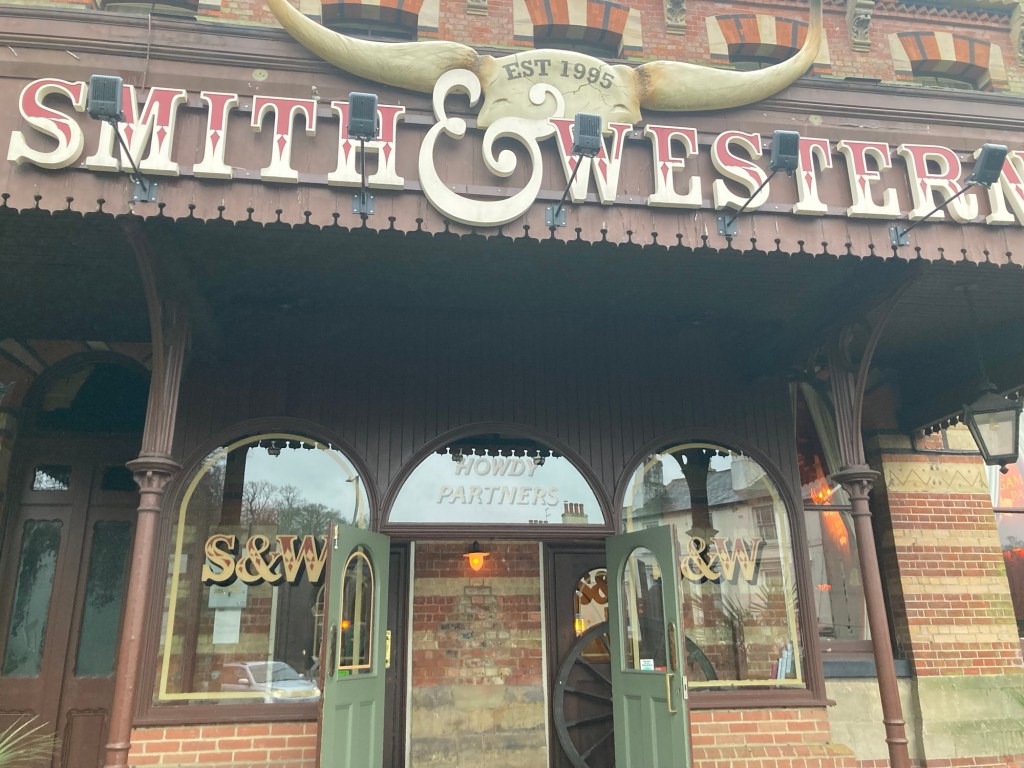
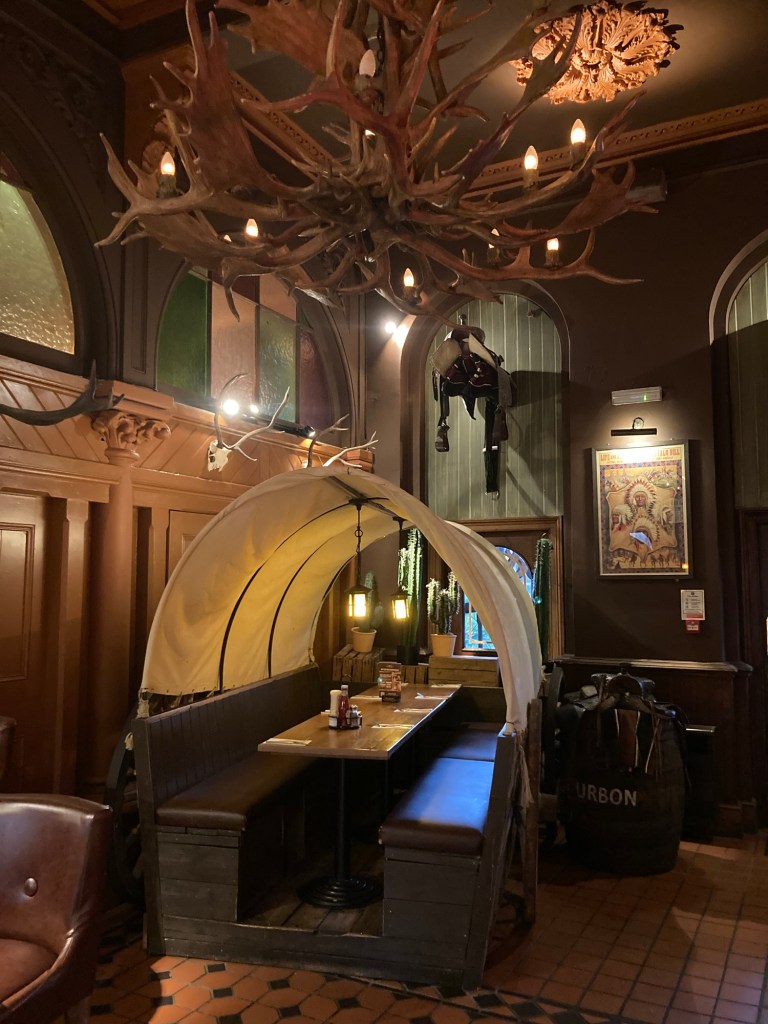
One view of the former train station,
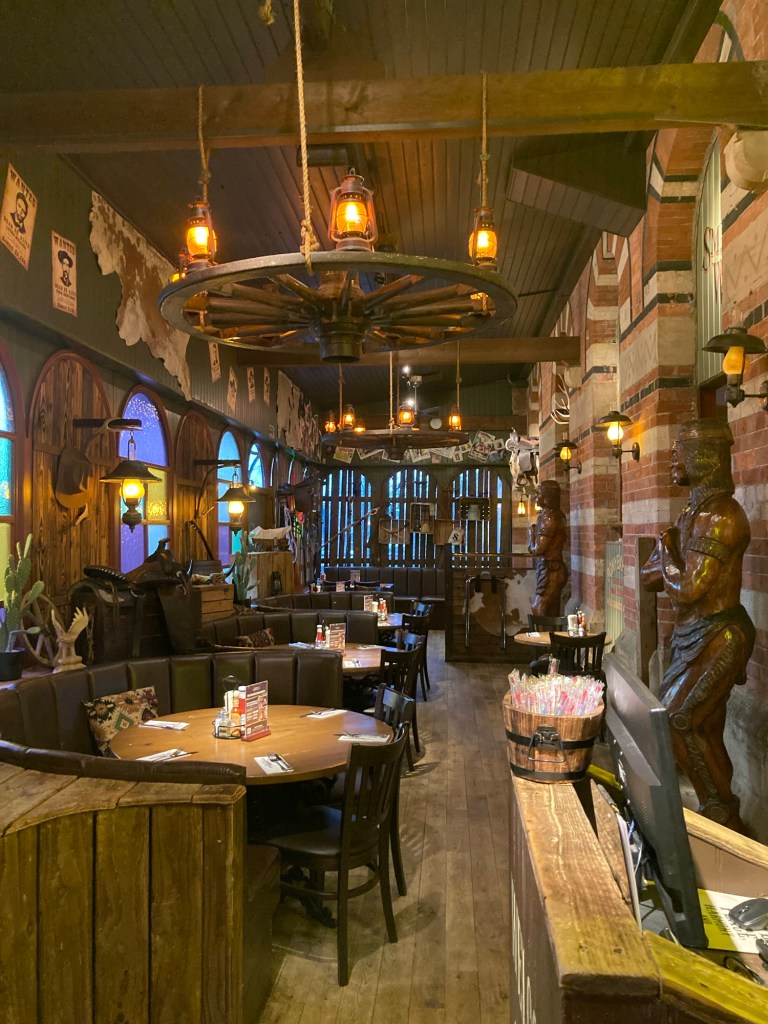
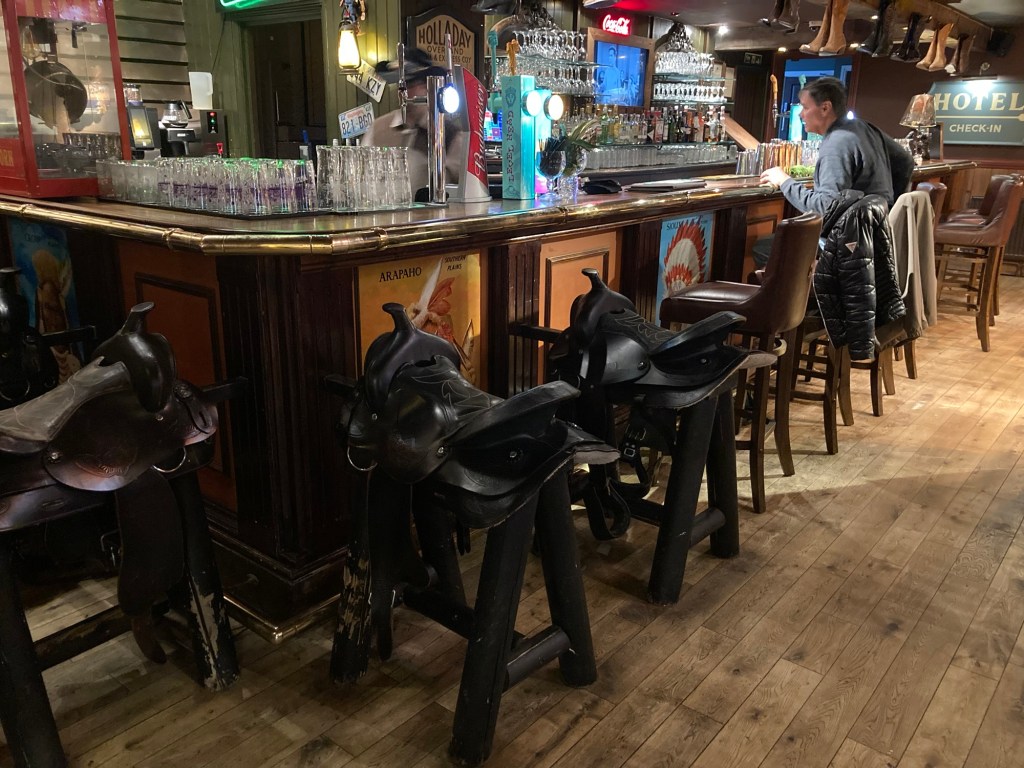
that is now a Smith and Western Hotel
with a western-themed bar and restaurant.
The front of the now Smith and Western Hotel.

After a quick shop, we headed back to the house and saw another repurposed important posting. Bob and I sucked in our stomachs, thought light, happy thoughts, and successfully made it across the bridge.

We were impressed with the signage but are hoping it is known to the NatSav, so that large trucks aren’t having to learn about the weak bridge at this point as it seemed like having to back up on either end would create havoc for the truck and any other traffic.

Categories
Uncategorized

The Pantiles and High Street (1/19/26)

One of the sites recommended for us to check out in Royal Tunbridge Wells was The Pantiles, a Georgian area of the town center featuring boutiques, cafes, and galleries, in addition to an exhibit regarding the spa waters that earned the town its Royal designation.

They sell bottles of the “famous” water out of a vending machine.
A list of the minerals found in the spring water
The walk and stores in The Pantiles
A cute seafood restaurant in a small square
A jewelry store under an old music gallery
An old corn exchange building,
where corn merchants would meet to arrange pricing with farmers
A statue in a small park in front of the Royal Victoria
A sign at one end of The Pantiles

We then walked back through the cute, small district to begin our perusal of the High Street. It was one of the longest and most vibrant High Streets that we’ve visited.

Here’s a happy corner — a cute bookstore and a gin bar
Helpful signage
A very attractive watch shop
Looking up the High Street
The train station
Shops in a former opera house
A cute square
Inside a two level mall at the top of the High Street
Categories
Uncategorized

A Warm Welcome to Royal Tunbridge Wells (1/17/26-1/18/26)

Bob and I arrived by train to Royal Tunbridge Wells yesterday afternoon a little after 2:00 pm. (Fun Fact: We went through the town of Tonbridge to get to Royal Tunbridge Wells.)

Our homeowner picked us up at the station. We had a great introduction to Nellie, our canine companion for this 31-day sit, and a thorough walkthrough of the lovely three floor home before the homeowners left at 5:00 pm for Heathrow airport to catch their flight to Rio. They will be spending a bit of time in Brazil before boarding a cruise around South America.

The exterior of our current abode
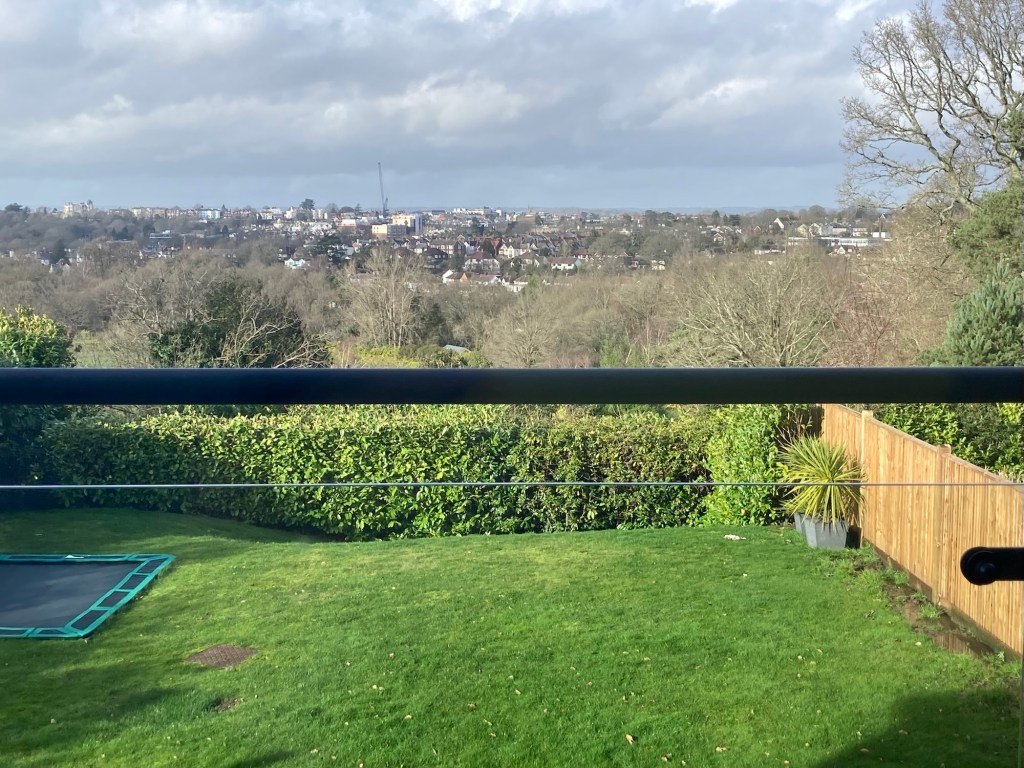
The view of their back garden and the town center
from the living room on the middle floor
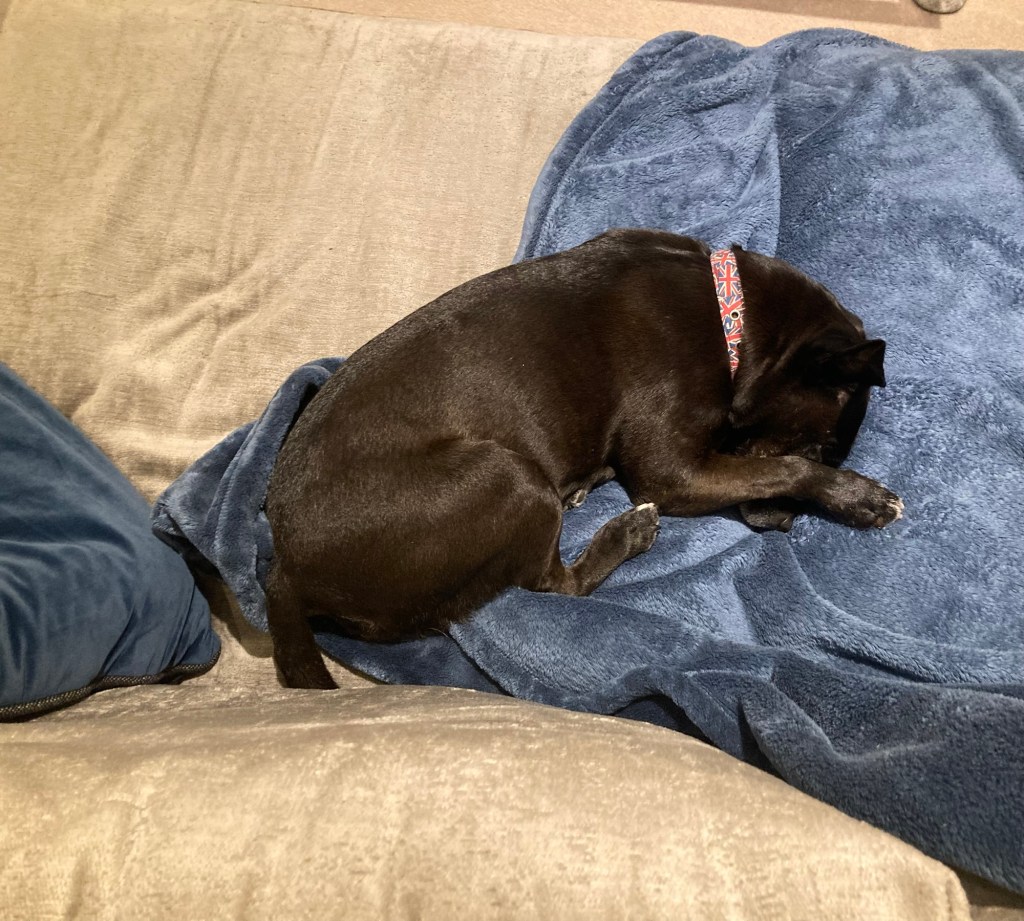
Nellie at rest
And playing with her favorite toy

Royal Tunbridge Wells (also just called Tunbridge Wells) is a town of about 60,000 people in Kent, England. It is 30 miles southeast of central London. The town was a spa during the Restoration and a fashionable resort in the mid-1700s. It was granted the prefix “Royal” in 1909 by King Edward VII, acknowledging its long history as a spa town frequented by royalty, especially his mother Queen Victoria. It is one of only 4 towns in England with the title. We have not yet been required to curtsy or bow to anyone.
This morning, Bob and I took Nellie out for her first walk of the day on one of the routes suggested by the homeowners. It gave us our first real glimpse of our current neighborhood.

Bob and Nellie
The impressive St. Mark’s Church that we passed
on our 70 minute walk
A proud sign on a corner near our house

After we returned to the house, we decided to visit Dunorlan Park, as today was to reach a high of 50 degrees F and was partly sunny. It is likely to be the best weather we’ll have for awhile if not the whole visit.

Dunorlan Park is a 78 acre park about a 35 minute walk from the house. It has a 6 acre lake as well as a cafe, exercise and play equipment, and boats for hire in warmer weather. The park was being well used today by walkers, dog walkers, and families.

This fountain was originally made by James Pelham
for the International Exhibition in 1862.
It is titled “The Dunorlan.”
“The Dancing Girl” by William Thees, 1951.
Entrance to the park near the Victoria Cross Garden
Photos and information on the local citizens
who were awarded the Victoria Cross,
the highest British war medal

This afternoon, Bob and I did a shorter walk with Nellie through a nearby cemetery.